The Craft
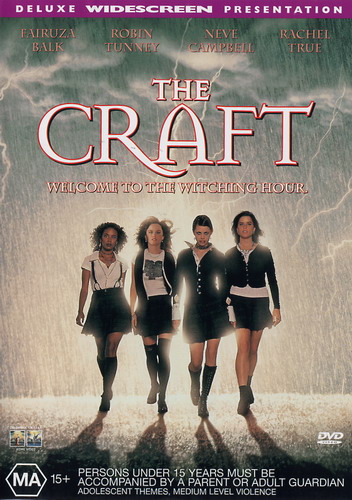
Details At A Glance
|
General
|
Extras
|
| Category |
Comedy |
Theatrical Trailer(s) |
None |
| Rating |
 |
Other Trailer(s) |
Yes, 1 - DVD trailer |
| Year Released |
1996 |
Commentary Tracks |
None |
| Running Time |
96:55 |
Other Extras |
None |
| RSDL/Flipper |
No/No |
Cast & Crew
|
| Start Up |
Menu |
| Region |
4 |
Director |
Andrew Fleming |
Studio
Distributor
|

Columbia Tristar
|
Starring |
Fairuza Balk
Robin Tunney
Neve Campbell
Rachel True |
| RRP |
$34.95 |
Music |
Graeme Revell |
|
Video
|
Audio
|
| Pan & Scan/Full Frame |
None |
MPEG |
None |
| Widescreen Aspect Ratio |
1.78:1 |
Dolby Digital |
5.1 |
| 16x9 Enhancement |

|
Soundtrack Languages |
English (Dolby Digital 2.0  ,
192Kb/s) ,
192Kb/s)
English (Dolby Digital 5.1, 384Kb/s)
French (Dolby Digital 2.0 ,
192Kb/s)
French (Dolby Digital 5.1, 394Kb/s) |
| Theatrical Aspect Ratio |
1.85:1 |
Miscellaneous
|
| Macrovision |
Yes |
Smoking |
Yes |
| Subtitles |
English
French
Dutch
Arabic |
Annoying Product Placement |
Yes |
| Action In or After Credits |
No |
Plot Synopsis
When this film arrived in 1996, the pagan community
online was in an uproar. Their reasons are as confused and diverse as the
objections to films such as Mad Love (a horrid film about
a young woman with bipolar disorder played by Drew Barrymore, of
all the people) that I have. However, most of it boils down to the accuracy
of the plot and the validity of The Craft's actual points,
whatever they might be. The plot mainly revolves around a teenaged girl
named Sarah (Robin Tunney), whose mother died in childbirth and
whose past is haunted by breakdown and suicidal behaviour. I found the
believability of this character to be utterly laughable, and she's probably
the best thing about this film. As she travels to a new life in a new town
with her father and some sort of consort (the film is not too clear on
this one-scene character's identity), she finds herself plunged into a
new school. After being treated in such a disgusting manner that would
basically get the single-digit-IQ perpetrators beaten to a pulp anywhere
else, Sarah basically falls in with a threesome of the greater losers in
this school . In order of priority, these are the egomaniacal Nancy (Fairuza
Balk), the dizzy and shallow Bonnie (Neve Campbell), and the
stereotypical Rochelle (Rachel True). I'd list the other characters
involved, but they match the four main stars - cardboard cut-outs. Sarah
is the only character in the whole film who gives the slightest suggestion
of a third dimension.
Once you get the taste of the obvious prejudices
of the media out of your mouth, this film is a much easier pill to swallow,
especially when presented in the DVD format. However, having said that
much, you have to have your mind in a really relaxed state to be
able to enjoy this film in spite of its stupidity. Shortly before it opened
in Australia, the advertising would have us believe that this is a horror
film, but nothing could be further from the truth. When I saw it in the
theatre, I came to the conclusion that it was a comedy. However, most pagans
tend to take an opposite view of this film, and I don't blame them. The
ending sequences of the film really sum the whole thing up - we could have
had a responsible, reasonable, and entertaining dissection of the dangers
inherent to entering a spiritual path of any sort, especially one such
as Wicca, with your eyes closed. Instead, what we get is a sequence of
totally unjustifiable special effects, extremely bad acting, and possibly
one of the silliest endings I've ever seen on a film of this sort.
Transfer Quality
Video
This is a refreshingly good transfer, with most of the
film receiving excellent treatment. According to some reports, there is
a major artefact during the beginning of the opening credits, where the
actual title of the film is displayed, about 1:20 into the film.
While the flickering and seizure-inducing frame changes are intended as
part of the exhibit, there does appear to be a few film spots in this sequence.
However, given how fast each frame flashes by in this part of the film,
I doubt you're really going to notice it unless you get out the slo-mo
button and actually start looking for it. Which, in my view, is more trouble
than the film is worth, especially given that this sort of artefact is
to be expected with this sort of sequence composition (astoundingly enough,
it actually appears to have been done using optical methods). The film
is presented in the aspect ratio of 1.78:1, and is 16x9 enhanced. The aspect
ratio is a bit of a waste, given that there really isn't much to get excited
about in the cinematography department, anyway. On the other hand, this
DVD contains some of the most well-detailed night-time sequences ever shot.
It's just a pity they were wasted on such a hysterical film with such an
incredibly poor plot.
As it is, there are no artefacts of any sort to be
found, unless you consider the deliberate fast-framing of the title shot
to be an artefact, and count the mild film artefacts that have resulted
from the manner in which this title shot is composited. However, in video
terms, the DVD version of this film comes up even better than the original
theatrical exhibition.
Audio
Again, this is an excellent transfer, although I somehow
disagree with the Hall Of Fame placement.
Maybe this is because I am severely biased against this film for its stereotyping
of just about everyone under the sun, but I think that is perfectly understandable.
There are four audio tracks to choose from in a choice of two languages:
English and French. Both languages have a choice between Dolby Surround
2.0 and Dolby Digital 5.1, although for some curious reason the disc defaults
to English Dolby Surround. I believe this film was originally exhibited
in Dolby Surround, so it makes sense to defer to the original cinematic
conditions. However, the Dolby Digital 5.1 mix has a little more appeal.
The dialogue was mostly clear and coherent, although
the points where it wasn't could be easily attributed to the fact that
the dialogue wasn't meant to be clear and coherent at those points. One
particular point where the clarity of dialogue suffers is a party at a
late point in the film. During this party, Nancy and Sarah confront each
other in the presence of Chris (Skeet Ulrich), who apparently has
mistreated them both, but the screaming and tantrums that ensue are more
punishment than even he deserves. Most of the other sequences in which
characters argue are not much better. In a film where a lot of the so-called
scares come from loud noise and jerky movements, cohesive dialogue tends
to be a secondary consideration.
The music of this film comes from various sources
within the MTV-approved pseudo-alternative "generation X" crowd. The only
pieces of music in this film which I found tolerable were to be found in
the opening credits (an interesting version of the Beatles' classic (a
contradiction in terms in my view but I'm not here to criticise music)
"Tomorrow Never Knows" by Our Lady Peace) and the end credits (Heather
Nova's "I Have The Touch"). I consider them to be third-rate versions
of other songs which I possess somewhere in my CD collection (most notably
David
Bowie's Ashes To Ashes and
Sons Of The Silent Age), and
they are the best songs on offer in the soundtrack album. I don't think
I need to say any more.
Extras
Only one thing on this disc that vaguely qualifies as
an extra - an advertisement extolling the virtue of the DVD format. The
advertisement in question begins with a graphic of a disc spinning through
a spacescape, and then shoots off into clips from other films that are
designed to excite the user about the wonders of a new format. Putting
such an advertisement on anything other than an esoteric demo-disc is really
not a smart move, in my ever-so-humble view. While this extra would be
suitable for a salesman in an electronics store, it doesn't have a place
in the home user's collection.
Summary
I honestly believe that the video quality of Columbia's
DVD releases are directly and inversely proportional to the actual quality
of the film on them. Compare the difference between The Craft
and The Thing, and you'll see
what I mean.
The video quality on this DVD is truly reference
quality. I wouldn't be too surprised to see it being used to demonstrate
the DVD format at one of the Hi-Fi stores in my local area.
The audio quality is mostly great, but there are
moments when you may find it annoying. Except for one sequence, there are
occasions when the music also seems to be at twice the volume of the dialogue.
The extras verge on the negative-value and insulting.
| Video |
 |
| Audio |
 |
| Extras |
|
| Plot |
 |
| Overall |
|
© Dean McIntosh
January 13, 2000
|
Review Equipment
|
| |
|
| DVD |
Grundig GDV 100 D |
| Display |
Panasonic 51cm and 68cm sets |
| Audio Decoder |
None |
| Amplification |
Sony STR-DE535 |
| Speakers |
Panasonic S-J1500D x2, Sharp CP-303A x2, Sony SS-CN120
Centre Speaker |