Memoirs of a Geisha (2005) |

|
Memoirs of a Geisha (2005) |
|
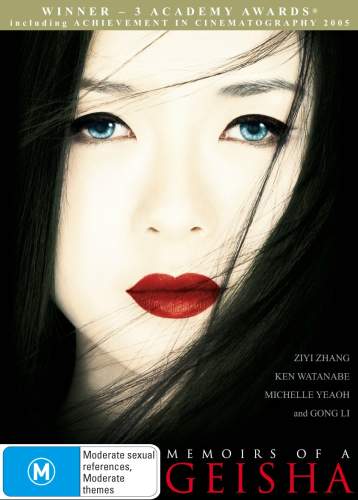

|
| BUY IT |
| General | Extras | ||
| Category | Drama |
Main Menu Audio & Animation Featurette-Geisha Boot camp, Building The Hanamachi Featurette-The Look Of A Geisha, The Music Of "Memoirs". Gallery-Photo-Behind The Scenes, Costume Illustrations Audio Commentary |
|
| Rating |

|
||
| Year Of Production | 2005 | ||
| Running Time | 147:49 (Case: 145) | ||
| RSDL / Flipper | Dual Layered | Cast & Crew | |
| Start Up | Menu | ||
| Region Coding | 4 | Directed By | Rob Marshall |
|
Studio
Distributor |
Spyglass Entertain. Roadshow Home Entertainment |
Starring |
Ziyi Zhang Suzuka Ohgo Ken Watanabe Kôji Yakusho Youki Kudoh Li Gong Kaori Momoi Tsai Chin Zoe Weizenbaum Cary-Hiroyuki Tagawa Kenneth Tsang Randall Duk Kim Ted Levine |
| Case | Amaray-Transparent-Secure Clip | ||
| RPI | $39.95 | Music | John Williams |
| Video | Audio | ||
| Pan & Scan/Full Frame | None |
English Dolby Digital 5.1 (448Kb/s) English Audio Commentary Dolby Digital 2.0 (192Kb/s) English Audio Commentary Dolby Digital 2.0 (192Kb/s) |
|
| Widescreen Aspect Ratio | 2.30:1 | ||
| 16x9 Enhancement |
 |
||
| Video Format | 576i (PAL) | ||
| Original Aspect Ratio | 2.35:1 | Miscellaneous | |
| Jacket Pictures | No | ||
| Subtitles |
English English Audio Commentary English Audio Commentary |
Smoking | Yes |
| Annoying Product Placement | No | ||
| Action In or After Credits | No | ||
Based on a best-selling novel, Memoirs of a Geisha tells the story of a young Japanese girl named Chiyo who is sold to a geisha house in 1929. Not content with her fate, Chiyo tries to escape and is seriously injured in the process. As a result, the house security is tightened and all hope of escape fades. Growing up as a servant in the house it is expected that she will slowly be trained and learn the art of the geisha. However, Chiyo is rebellious by nature and the owner decides she is too much trouble. Instead of becoming a geisha she will be a slave of the house.
A chance encounter with a kind stranger gives Chiyo hope that she can make something more of her life. The only way to do that is to become a geisha. A nearby geisha house owner, Mameha, sees the potential in Chiyo and offers to train her. Hatusmomo, the star geisha begins to see Chiyo as a threat and throws up obstacles that threaten to derail her attempts to become a geisha. World War II begins and Japan is thrown into turmoil. Will she ever find happiness and true love?
Like many movie fans, I have a love/hate relationship with novel to film adaptations. Having been burnt too many times, I have become jaded by Hollywood's attempts to translate best selling novels to the big screen. The two mediums are so different, and yet can work so well together when executed properly. Adaptations that take the essence of the novel's concept, drop some of the weaker elements and make it more 'film-friendly' like The Bourne Identity are a treat for fans of the novel and movie goers alike (even if the final film doesn't come close to resembling the book.) However, commercial successes that stay relatively close to the source, like the recent Da Vinci Code or the Jurassic Park follow-up The Lost World often leave a bitter taste with fans of the novel, even if they do rake in the dollars at the box office.
Memoirs of a Geisha is a brilliant novel, a fascinating look at the mysterious and hidden world of the geisha. Ironically, the insightful novel was written by a gaijin, Arthur Golden, who interviewed actual geisha from the era the novel was set in. A critical hit and best seller, it didn't take time for the film rights to be snapped up. Originally Steven Spielberg was touted to helm the film, however due to development issues and scheduling, the film eventually ended up in the lap of Rob Marshall, the Academy Award winning director of Chicago.
It is here that my disappointment with Memoirs begins. Marshall has very little directorial experience and I found Chicago to be a completely underwhelming and disappointing film. (I'll never be able to comprehend how Moulin Rouge could not win Best Picture but the next year Chicago could
The novel covers a period of twenty plus years and as such the movie has to cram a lot into it. Unfortunately, the film tends to drag partly because viewers never get much of an emotional attachment to the key characters. Beautifully shot but emotionally void is perhaps the simplest way to sum the film up. The cinematography, sets, and costumes in this film are truly impressive. With an Oscar in tow, Marshall really had power to stump up for cash. No dollar was spared and on screen it shows. Unfortunately the effort put into those production elements falls dramatically short on the screenplay. Whilst telling the story of the novel, it fails to connect emotionally like the novel did. It's hard to sit through a 150 minute movie when you can take or leave the key characters.
There was also a bit of controversy as far as the casting went. Being a movie about one of the most mysterious and misunderstood Japanese icons, the casting of non-Japanese actors in key roles outraged many and the film attracted a lot of negative press about it. Personally, it's a non-issue for me. The novel it's based on was written by an American and the film was shot in California, so why does the casting of a few Chinese actresses cause a media frenzy?
Speaking of the cast, I was really impressed. Zhang Ziyi did a good job as Chiyo. It's pretty obvious that she's not a very confident English speaker and that vulnerability actually added to her portrayal. Michelle Yeoh was fantastic as Mameha. She's a beautiful woman and was radiant as the matronly mentor. Gong Li portrayed Hatsumomo as the conniving and jealous geisha very well. I could watch Ken Watanabe all day. He's a great actor and he doesn't disappoint.
The book is a classic, but this film fails to reach those heights. However, it is an enjoyable and beautiful look at one of the most misunderstood cultural icons of Japan.
This PAL disc is presented at 2.30:1 and is 16x9 enhanced.
Beautifully shot, it is hard to fault this transfer. The picture is clear and enjoyable to watch.
Colours are wonderfully vivid - the cherry sakura blossoms are pink, the costumes look amazing, and autumn colours are vivid in their earth tones.
Skin tones look natural.
Black levels are good, and shadows are decent too.
There are no MPEG artefact issues nor are there any film artefact problems.
This is the type of transfer that studios should deliver more often.
| Sharpness |   |
| Shadow Detail | |
| Colour | |
| Grain/Pixelization | |
| Film-To-Video Artefacts | |
| Film Artefacts | |
| Overall | |
The audio track is a competent Dolby Digital 5.1 (448kb/s.)
The dialogue is good, but at times can come through a little too soft. This can be problematic when you have non-native English actors speaking heavily accented English.
There are no sync, click or drop out issues.
The score by John Williams is beautiful, adding to the scale of the film and it sounds first class.
The surrounds get some use, but it is an extremely front heavy track.
The sub-woofer pretty much gets the night off. It gets very limited use, but this film doesn't have a track that really needs it.
There are also two English Commentary Dolby Digital 2.0 (192kb/s) tracks.
| Dialogue | |
| Audio Sync | |
| Clicks/Pops/Dropouts | |
| Surround Channel Use | |
| Subwoofer | |
| Overall | |
Featuring director Rob Marshall and co-producer John DeLuca. Issues discussed include the difficult process of adapting the long novel to the big screen, and also the logistical exercise of overcoming the language barrier. With English, Japanese and Chinese speakers on set Marshall found it unnerving to rely on translators to communicate his vision and instructions to the actors. They also speak a lot of about the imagery and amazing sets used in the film.
Features costume designer Colleen Atwood, production designer John Myhre, and film editor Pietro Scalia. Interesting because the costumes and sets for the film are amazing.
Geisha Bootcamp (12:04)
Interesting look at how the actresses prepared for the art of the geisha in 6 weeks. Skills included playing the shamisen, dancing, pouring sake, and walking like a geisha.
Building the Hanamachi (12:20)
Amazing look at the set design. Japan was too modern, so they built the geisha quarters from scratch in California.
The Look of a Geisha (16:07)
A look at the costumes, make up and hair design to get the look right for the film.
The Music of Memoirs (9:55)
Includes an interview with John Williams. Apparently, this was the first film he has asked to write the score for. It's a beautiful soundtrack.
NOTE: To view non-R4 releases, your equipment needs to be multi-zone compatible and usually also NTSC compatible.
Unfortunately this is another instance where R4 gets an inferior release.
The R1 release has another 7 featurettes that we miss out on. The R1 release was a 2 disc set, R4 is 1 disc.
Sayuri's Journey: From the Novel to the Screen
The Road to Japan
A Geisha's Dance
The World of the Geisha
The Way of the Sumo
Rob Marshall Featurette
A Day with Chef Nobu Matsuhisa
Overall, a beautifully shot film that could've been great.
The transfer is great.
The audio does the job well.
The special features are decent, but we miss out on a few featurettes.
| Video | |
| Audio | |
| Extras | |
| Plot | |
| Overall | |
| Review Equipment | |
| DVD | Marantz DV4300, using Component output |
| Display | Sony VPL HS10 projector on 100 inch 16x9 screen + Palsonic 76WSHD. Calibrated with THX Optimizer. This display device is 16x9 capable. |
| Audio Decoder | Sony STR-DE685. Calibrated with THX Optimizer. |
| Amplification | Pioneer |
| Speakers | DB Dynamics VEGA series floor standers + centre, DB bipole rears, 10" 100W DB Dynamics sub |